






Features
-
For new alumni’s drone dreams
-
How ants effectively fight pathogens
-
Wendland family recognized nationally
-
Alabama Extension brings educational content
-
The fight against the cotton jassid
-
Grad students share story of overcoming hardships
On the cover
In every issue
-
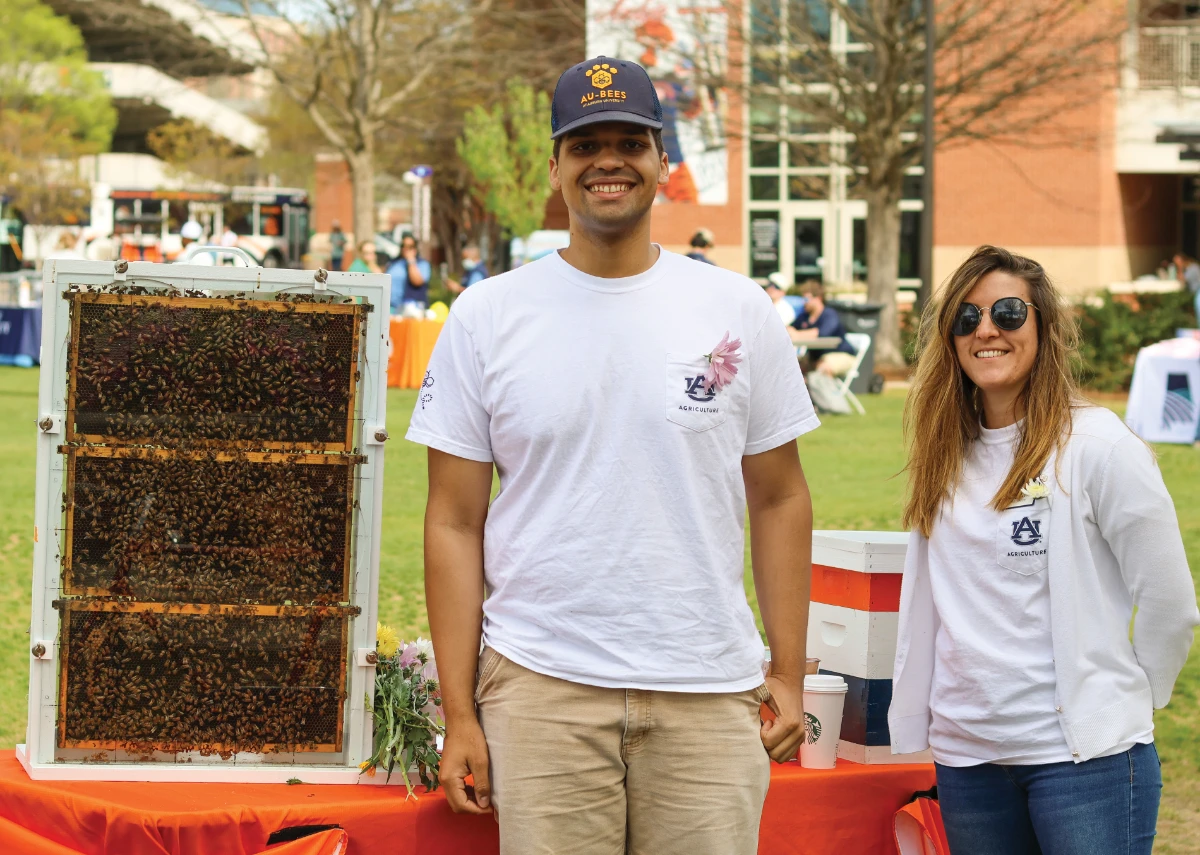
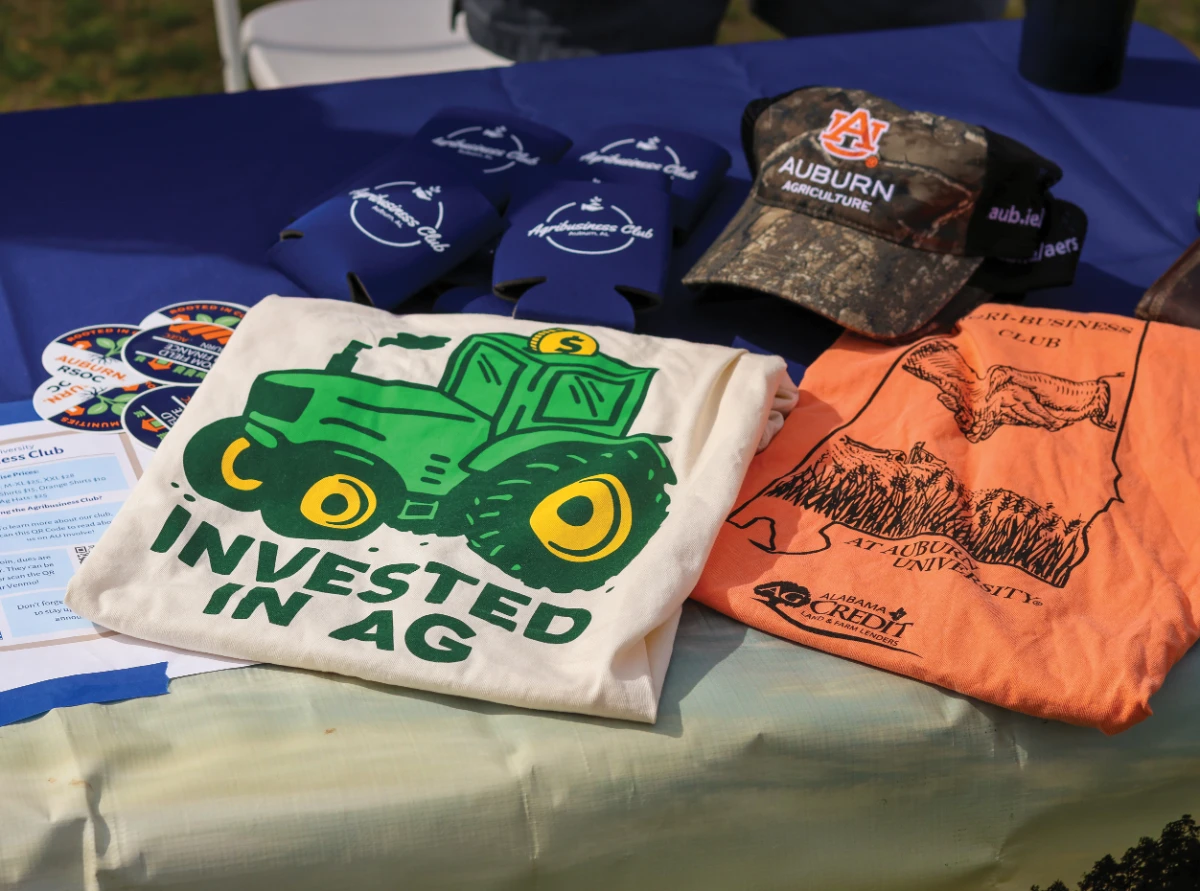
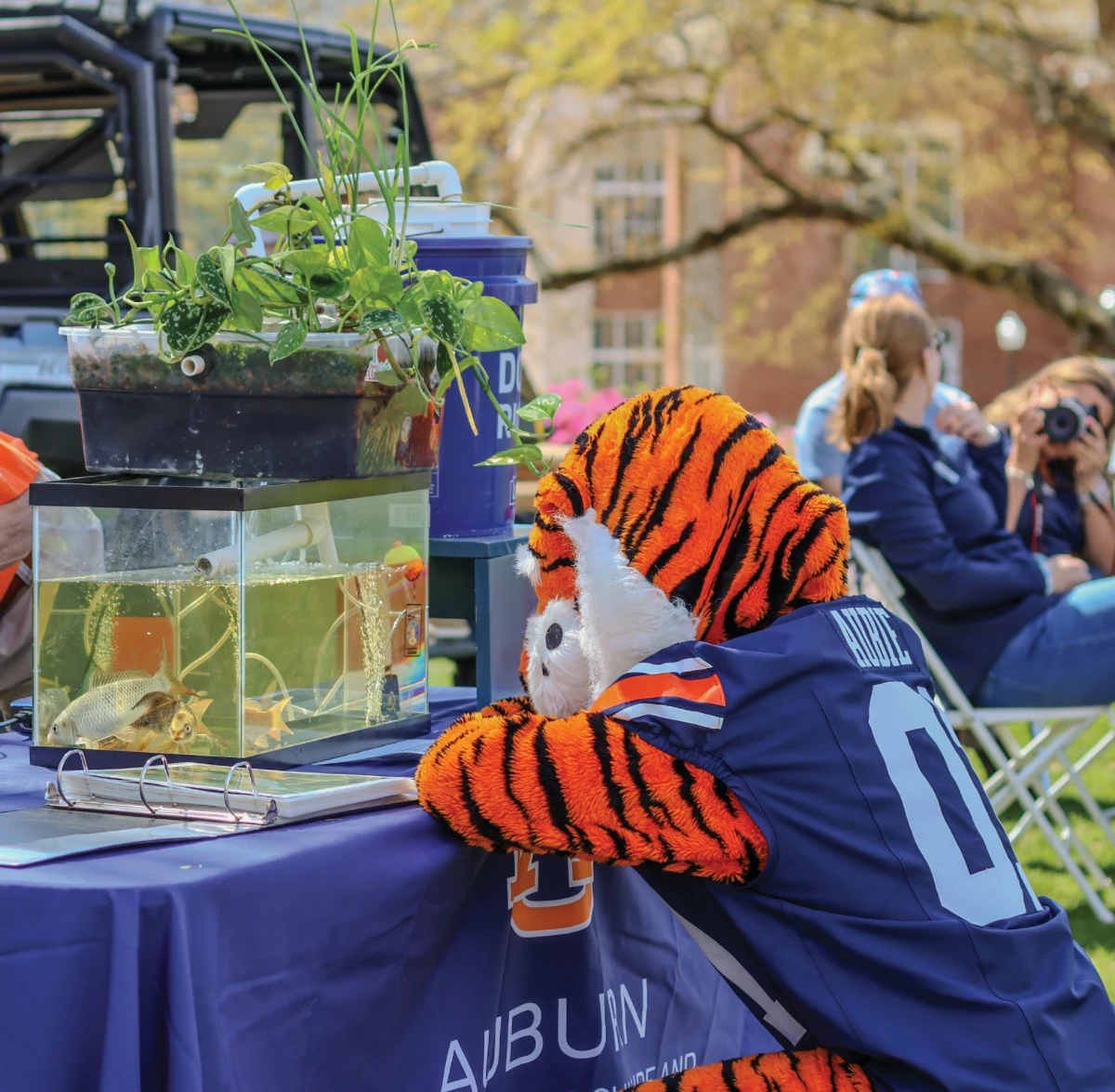
A celebration of National Ag Week
-
A Q&A with Variety Testing Manager Henry Jordan
-
Lauren Isley shares her Granny B’s blueberry salad
Deeply Rooted


plays longtime partner for
Auburn’s turfgrass program

Deeply Rooted

Bentgrass — the cool-season turf used on many championship golf greens — is infamously temperamental in Southern heat. When temperatures climb and humidity is heavy, superintendents across the region brace for stress, disease and sometimes outright loss. But here, on a winding country road outside Birmingham, they’ve proven tougher than anyone expected.
Part of that success comes down to design. Part of it is patience. And part of it is due to a grass variety born at Auburn University.
Together, those elements have helped Bent Brook become something rare in modern golf: a public course built to last.
ent Brook owner, Auburn alumnus James “Jimmy” Coleman Lee III, was already an avid golfer when he first imagined opening a course in the 1980s.
Lee is the fourth-generation CEO and former president of Buffalo Rock Company — the largest privately-held, family-owned Pepsi Co. bottler in the United States — which was founded by his great-grandfather Sid Lee in 1901.
With a deep knowledge of golf and a head for business developed in Auburn’s Harbert College of Business, Lee knew the math of public golf depends on play volume. But more golfers also mean more wear on turf.
Lee’s solution was unusual: build 27 holes instead of 18.
The extra nine would allow the staff to rotate play, resting one course at a time while the others handled the traffic.
“It had to be 27 because you could rest the nine,” Lee said. “Otherwise, 18, you were going to wear the greens out.”
That decision proved crucial almost immediately. When Bent Brook opened in 1988, demand was strong.
“I think the first 12 years we did minimum 50,000 rounds a year,” Lee said. “That’s a lot of rounds.”
Another way to think about it? That’s roughly 140 golfers a day, every day of the year.
The three-course rotation — known as Brook, Graveyard and Windmill — allowed the maintenance team to move golfers while giving turf time to recover from foot traffic, among the greatest stressors for turfgrass.
Director of golf Jeff Alcorn said that commitment to quality has defined the course from the beginning.
“It’s an upscale daily golf course open to the public,” Alcorn said. “It has a country club feel and condition, just to give public golfers a quality golf course. That’s been Mr. Lee’s gift to Birmingham.”
Lee almost stumbled upon the land that now is home to Bent Brook. He was driving along Interstate 459 one day in the 1980s when he spotted a stretch of open pasture and began imagining fairways instead of fields.
“I looked over here and saw this — looked like pastureland,” Lee said. “And I went, boy, it looks like that’d make a good golf course.”
But finding the land was only the beginning. Buying it was another matter.
“I had a hard time getting a loan,” Lee recalled. “A very hard time.”
At the time, the area around the interstate exit was mostly undeveloped. Convincing lenders the location would eventually grow took persistence. Now, the landscape has changed dramatically — hospitals, businesses and neighborhoods filling what was once a deserted exit off the interstate.
“I tell people we beat McDonald’s to this exit,” Lee said.


-Scott Mcelroy
aintaining bentgrass greens in Alabama has never been easy. Heat, humidity and disease pressure make the turf notoriously difficult to manage.
Around 2010, Bent Brook faced a major outbreak of Pythium volutum — a destructive turf disease that swept across the region.
“We had a bad outbreak,” Superintendent Johnny Perry recalled. “It was all throughout the greens. It came out of nowhere. We didn’t really know how to fight it.”
Looking for alternatives, the Bent Brook team decided to experiment with several bentgrass varieties, one of which was AU-Victory, a new line developed through Auburn’s turfgrass breeding program.
Perry’s team stripped an existing putting green and planted three test plots. Then they did something most superintendents would never do.
“We’re not going to water it. We’re going to see how tough it is,” Perry recalled saying. “And that was the whole test.”
For three years, the plots were left largely alone — just minimal irrigation at the end of the day. They reevaluated the approach annually. By the end of the experiment, the results were obvious.
“The AU-Victory was looking great,” Perry said. “And the other part of the green was stressed and thin.”
That performance convinced the Bent Brook team to move forward with a full renovation using AU-Victory, making them the first course to fully implement the bentgrass variety developed at Auburn.
The biggest surprise wasn’t that the grass survived Alabama’s summers, but how well it handled stress. When Professor Emeritus Dr. Edzard van Santen — the breeder who developed AU-Victory — came up to examine the turf’s roots within the first year after installation, he found roots 10-12 inches deep.
Deep roots allow the grass to access moisture far below the surface — a critical advantage during periods of extreme heat. Soon, other courses in the area took note of Bent Brook’s success, and the course’s leadership offered guidance to their peers in the care and maintenance of AU-Victory.
“The more I try to kick this grass’s — excuse my language, but — ass, the better it responds,” Perry said, laughing.
The real danger, he discovered, wasn’t drought, but water. Overwatering — especially during intense heat — can damage bentgrass by trapping moisture and reducing oxygen around the roots.
“So, I literally have a rule: If I catch anybody dragging a hose after 11, I say, ‘Stop. It’s fine,’” Perry said. “It likes to be drier. It really does well in the stress and heat.”
The AU-Victory variety was first developed by van Santen and produced by Mountain View Seeds.
“Dr. Edzard van Santen specifically focused on selecting a bentgrass variety for heat and drought tolerance that would be adapted to the U.S. transition zone and further south,” said Auburn Professor of Turfgrass Management Professor Scott McElroy. “Northern breeding programs also select for these qualities, but selecting for these specific characteristics in Alabama really challenges the various selections to survive.”

early four decades after opening, Bent Brook remains a fixture in Birmingham’s public golf community.
The solid-wood clubhouse furniture still shows the gentle wear of decades of golfers passing through. The staff includes longtime employees who have helped maintain continuity through years of change.
Lee said that stability — along with a shared commitment to the course — has been central to its success.
“You’ve got to have a great superintendent,” he said. “Johnny has just done a great job consistently.”
But Perry and Alcorn say the true testament is in the course’s leader.
“You can’t do justice to what he’s done for golf in Alabama,” said Alcorn, who has worked at Bent Brook for 18 years. “He never turns down an opportunity to support a junior event. It costs us a lot of money to do so, but for him it’s never about the cost.”
That investment in the future of golf pays dividends. Bent Brook was the first purely public course to hold an amateur, the Alabama Golf Association’s State Amateur Championship, in 2004. And when the world came to a halt in 2020, Bent Brook was able to weather the storm.
“We were ready to close,” Alcorn said honestly. “But we held out. And when everyone could get outside again? Boom.”
Golf has changed in the last decade, according to Alcorn. It’s more accessible than ever and has wider interest thanks to attractions like Top Golf. Golf play nationally is up 40% since pre-pandemic numbers, he said.
“It’s always been true, but I think it’s more understood than ever that it is really about having fun,” Alcorn said. “It’s about getting out, getting some exercise. That’s always been true here.”
McElroy described Bent Brook as “what golf needs to be.”
“If we want golf to grow in Alabama, we need to be looking to Bent Brook as an example of how to grow the game of golf through publicly available courses,” he said.
“They also took a risk and trusted Auburn researchers to provide a cultivar that would benefit our southern climate,” he continued. “They looked at our data and trusted us in what we were providing. This was immense in helping AU-Victory to get off the ground — or in the ground, so to speak.”
McElroy said Bent Brook remains a quality partner to the Auburn turfgrass program, creating potential for training and internship opportunities for students.
“They want to see golf grow in the state, and they know it starts with training the next generation of golf course managers,” he said. “We have also been in discussion with them about the development of a turfgrass research area at Bent Brook to expand our research areas to the Birmingham area. This would put our research trials on a golf course and expand our ability to conduct research right in the area where most of our golf courses are located.”
Perry — who has worked for Bent Brook for more than 30 years — and Alcorn agreed there is one other crucial ingredient to Bent Brook’s continued success.
“I couldn’t work for a better guy,” Perry said of Lee. “We get to come to work, do our jobs and do them well, working for someone who always listens to our ideas. Because of him, we can do our jobs and make this place the best we can.
“That’s really special.”

The Sky’s the Limit
In war, drones have become ubiquitous with death and destruction, as opposing sides have pushed the technology further than ever before in search of a battlefield advantage. On another level, privately operated drones have become a frequent nuisance, sometimes closing airports, disrupting mass events or invading people’s privacy.
But two recent graduates from the Auburn University College of Agriculture, John Hixon and Carter Engle, are hoping to convince more people — especially Alabama farmers — to see drones in an entirely different light.
While finishing school, they launched Elevated Ag Drone Services (EADS), which provides agricultural drone services for the application of pesticides on crops, spraying herbicides on weeds and numerous other applications where drones can save time and money over more traditional technologies.
Ironically, neither Hixon nor Engle came from agricultural backgrounds prior to coming to Auburn and the College of Agriculture. “I just knew I loved being outside and wanted a career that allowed me to work outdoors,” Hixon said. “That led me to choose an agricultural major, and I haven’t looked back since.”
For his part, Engle first declared a major in pre-med when he arrived on the Plains. He soon decided he wanted something different, and his friend Hixon thought he knew just the thing. He encouraged Engle to make the switch to agriculture, and it didn’t take long for the switch to become permanent.



“During spring of my freshman year at Auburn I was looking for a summer job and a pledge brother told me about a position he had held before with the college,” Hixon recalled. “I met with Dr. Steve Li, and he explained his projects with agricultural drones. I had never even heard of agricultural drones before that, but it sounded fascinating, and I really fell in love with it. I ended up spending two summers working with him, and that’s where my interest really began.”
Li, an Associate Professor and Extension Specialist in the Department of Crop, Soil & Environmental Sciences, is one of the nation’s foremost experts on the use of drones in agriculture. He has worked closely with the Alabama Farmers Federation to demonstrate drone technology across the state and reaches subscribers in 25 countries with his online educational content.
Engle once again followed Hixon’s lead and also ended up working with Li. “After John’s first summer working with Dr. Li, he encouraged me to come join the team and check out the drones,” Engle said. “It sounded like a great opportunity to stay in Auburn for the summer and work with some good guys. Little did I know how interesting the drone technology would be.
“Dr. Li played a huge role in the start of my interest in drones,” he continued. “Without him I probably never would have discovered this path. Even now he continues to pour into us and is always willing to answer questions or help however he can.”
According to Li, Hixon and Engle not only had a burning desire to learn as much as possible, but they also possessed another very important characteristic necessary to success in agricultural drone work.
“They had an exceptional work ethic and were never afraid of hot and dirty work outside in the middle of the summer,” Li said. “They took on the toughest jobs with a great attitude and were always eager to learn new things.”
The two were so eager, in fact, that with Li’s help they soon started looking for opportunities to work with established companies so they could expand their knowledge even more.
“We were running research trials and wanted to get more hands-on experience flying spray drones,” Engle explained. “Dr. Li posted our contact information in a Facebook group for spray drone operators and from there, we started calling the numbers in the comments. After many phone calls we found a company in Tuttle, Oklahoma, willing to let us come work for the summer.”
Hixon and Engle spent that summer living in a tiny fifth-wheel camper and working at Sky Tech, LLC, a small father-son drone operation serving Oklahoma farmers.
“We only had about 15 minutes of combined phone conversation with our boss, Michael Bradford, before heading out there,” Engle remembered. “But the family was amazing and welcomed us like their own.”
It was in Oklahoma, gaining hands-on experience every day in maintaining and operating working agricultural drones, that the pair first had the idea of bringing that experience back home to Alabama and starting their own drone operation.
“Once we started operating the drones and seeing how much acreage they could cover, we realized there was real potential there,” Hixon said. “There was a real demand for that kind of service. That’s when we started thinking about building something of our own.”
“Pretty quickly during our time in Oklahoma we realized this could turn into something long term,” agreed Engle. “We learned the software side of the operation, how to troubleshoot problems in the field and even how to disassemble and repair the drones when needed.
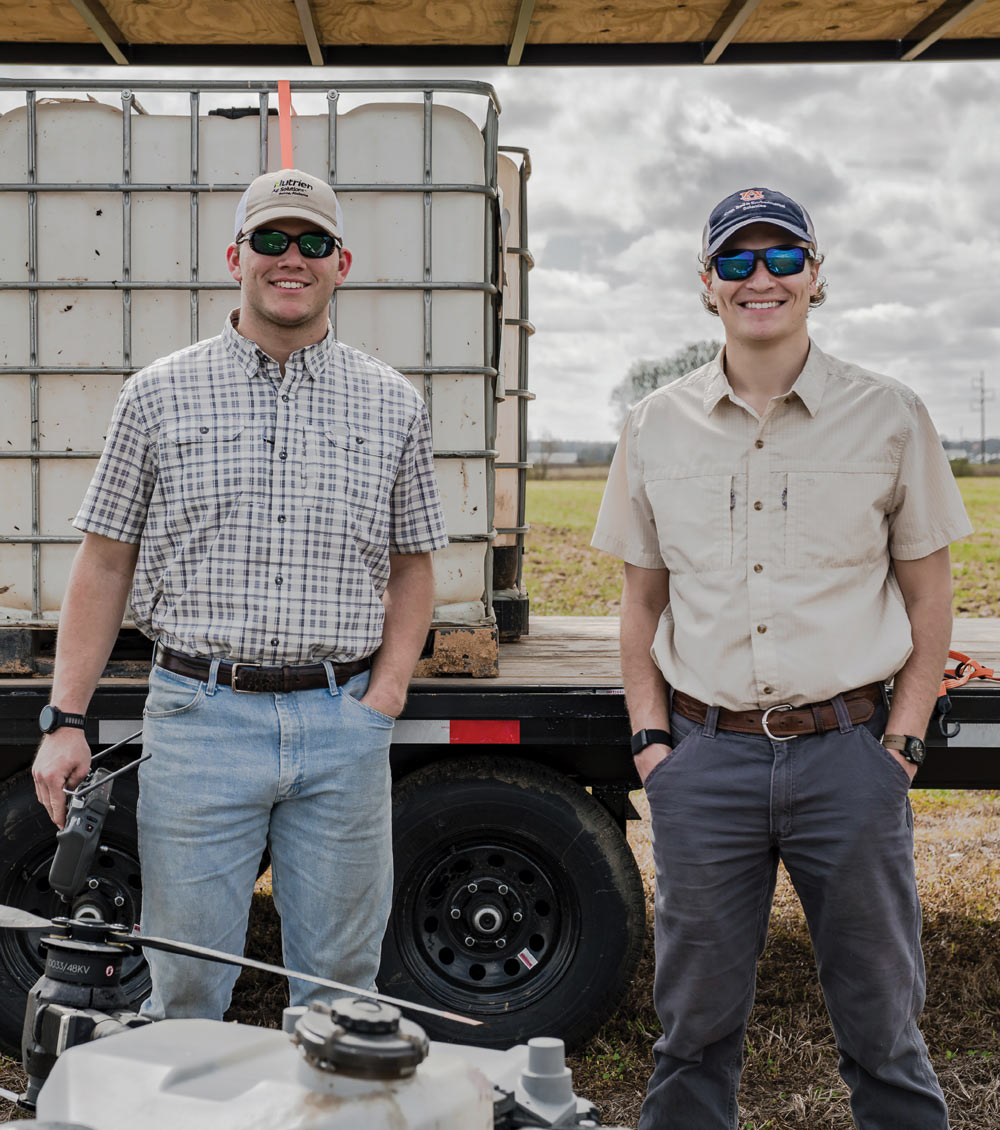


The two also learned more about the regulatory side of the business. Due to drones competing with other aerial vehicles for airspace and their potential for possible misuse, drone operation is highly regulated by federal authorities.
“To open our own business, one of the first steps was obtaining our Federal Aviation Administration (FAA) Part 107 Remote Pilot Certificate, which required passing an in-person exam,” Engle said. “After that, we had to obtain our FAA Part 137 certification, which allows us to operate agricultural aircraft over 55 pounds.
“That process involved months of paperwork and close coordination with the FAA. But there are several certifications and requirements that must be completed before being fully legal to operate.”
But the result of the experience gained with Li in the college and at Sky Tech in Oklahoma is their new company EADS, which for now offers drone applications across several counties surrounding the Auburn area. Hixon and Engle have found the technology to be highly suitable to Alabama agriculture, built as it is mostly around small, family-operated farms.
“Drones are a great fit for smaller properties where aircraft may not be able to operate,” Hixon noted. “They’re also useful when fields are too wet for ground rigs. On top of that, drones can be more affordable compared to other application methods.
“Drones can also save a significant amount of time. In many cases, they can treat fields several times faster than traditional methods, especially in situations where ground equipment can’t access a field due to soil conditions. They allow farmers to respond quickly to problems in their crops, which can make a big difference during critical growing periods.”
“Drones aren’t here to replace crop dusters, helicopters or ground rigs,” added Engle. “They’re here to complement them. They create new opportunities for efficiency, allowing access to areas that were previously difficult to reach and giving farmers another tool that can help improve yields over time.”
The relatively small drones EADS uses have impressive capacity and the ability to get a job done quickly.
“Capabilities vary depending on the job, but the drones we primarily use are around 10 by 10 feet in size and can fly at roughly 32 feet per second,” Hixon said. “They are capable of applying up to 10 gallons of pesticide, herbicide or fertilizer per acre, which allows them to very efficiently treat fields or problem areas while maintaining precise application amounts.”
Hixon and Engle graduated in May with hopes to expand their business to other areas of Alabama and beyond. As far as they can tell, the sky is the limit for the use of agricultural drones in the years ahead.
“Drones aren’t here to take over agriculture, but they are here to help,” predicts Hixon. “I think we’ll see a lot of continuing innovation in the use of them in other areas such as forestry and land management. There’s still so much to discover with this technology.”
“And drones will only continue to improve,” adds Engle. “Looking at a drone from five years ago feels like looking at an iPhone 6 today. The technology is advancing so rapidly that it is very exciting to think about what the next few years will bring.”


The Comer 150 Campaign

Together, we are rebuilding a legacy for tomorrow.
College of Agriculture
Attn: Office of Development
Haley Center 5092
351 W Thach Concourse
Auburn University, AL 36849


HOW ANTS EFFECTIVELY FIGHT PATHOGENS
Auburn University Assistant Professor of Entomology Clint Penick and a team of graduate students may have found that ants are ahead of humans in the development of antibiotics. He worked with Katy Chon, graduating master’s student from Kennesaw State University, and Darmon Kahvazadeh, Auburn entomology and plant pathology graduate research assistant, on research that was recently published in the Biological Journal of the Linnaean Society, a direct descendant of the oldest biological journal in the world, which published the epoch-making papers on evolution by Darwin and Wallace.
“In our study, we tested how ants use antibiotic compounds to fight off pathogens and asked why their chemical defenses remain effective over evolutionary time,” Penick said. “Humans have relied on antibiotics for less than a century, yet many pathogens have already evolved resistance, giving rise to ‘superbugs’ that are difficult to treat.”
“Ants, by contrast, have been using antibiotics for tens of millions of years, and they might hold the key to using these powerful drugs more wisely.”
The team looked at just six ant species, all found easily in the Southeastern United States.
“These are the ants that live in our backyards and live on college campuses,” Penick said. “And yet some of the most powerful antibiotics we found come from ants we typically think of as pests, like fire ants.”
In scientific terms, an antibiotic is something produced by a bacterium that kills other bacteria. But generally, an antibiotic is understood as anything that kills microbes, and this is what human medicine scientists have been doing since the 1950s.
“And yet we’re dealing with these massive superbugs that are difficult to control, and we’re losing the race,” Penick said. “They’re evolving resistance faster than we’re developing antibiotics. So, how have ants been able to do it for tens of millions of years?”
Penick and his team have two hypotheses.
“One is that they might produce multiple types of antibiotics and different types of chemical compounds,” he said. “It’s just like if you go to the doctor and they try one. If it’s not working, they’re going to try another one. Maybe ants have different medicines in their medicine cabinet, if you will. If a strain is resistant to one thing, we’ll try another — we found evidence that ants have the capability to do the same thing.”
Another possibility came from the researchers asking if ants can produce things that are targeted to specific microbes — one of science’s biggest challenges today.

“If it’s strep, they’re going to treat with a specific antibiotic that’s focused on strep,” he said. “And if it’s not strep, then it usually means it’s a viral infection, which will resolve on its own. We’re wondering if ants are doing the same thing.”
In human medicine, this kind of targeted approach is especially important because broad-spectrum antibiotics can disrupt the body’s natural balance of microbes, including those that make up the gut microbiome. That disruption can lead to common side effects like stomach upset or secondary infections — and it can also accelerate antibiotic resistance.
“If we just dump antimicrobials or antibiotics into systems that kill everything, we’re not only killing our target pathogens but also beneficial microbes,” Penick said. “And that can actually accelerate antibiotic resistance, because microbes can swap resistance genes.”
“This is something human medicine is very interested in — figuring out how to create more targeted antibiotics.”
The team found evidence that, at the very least, ants are producing some that are specific to fungi, some that are specific to gram-negative and some that are gram-positive bacteria.
“So, it seems like ants are producing more targeted compounds, just like we’re doing,” Penick said. “We could guess they might be doing so, but we don’t really know now.”
While not the primary focus of the paper, the team found that nearly all of the ant species tested killed an emerging human superbug — Candida auris. This pathogen has been spreading in hospitals with few options for control, yet ant extracts were highly effective against it.
The next step is to look at what types of compounds ants are producing and how they’re using them.
“It could help inform our own practices or potentially we could discover new compounds that have mathematical importance,” Penick said. “Our findings suggest that ants could represent a vast and largely untapped source of new antibiotics, including ones capable of combating today’s most dangerous drug-resistant infections.”
Their turn to tend the land
By Kacey Watson


College of Agriculture alumnus Drew Wendland and his family were recognized as the Outstanding Young Farm Family of the year by the American Farm Bureau Federation. Drew and his wife, Lauren, received the Achievement Award at the federation’s Annual Convention held in January in Anaheim, California.
“My family and I were honored to represent Alabama,” Drew said. “We were definitely surprised to win, because there were so many strong competitors. We are very blessed to have had the opportunity to do this together as a family.”
The Wendlands, operators of the Autauga Farming Company, were selected as Alabama’s state winners before taking home top honors nationally.
But this success did not appear out of thin air. For more than a century, the family has tended the land in Autauga County and Montgomery County. Making the most of their business, the operation includes cattle, cotton, feed grains — corn, oats, wheat — hay, and seed crops. Nestled in Autaugaville, Alabama, Autauga Farming Company has played a central role in the agricultural community since the early 1900s.
In recent years, Drew, his brother Dan and their father Andy have worked side by side, each overseeing a piece of the farm’s daily operations.
With a laugh, Drew recounted his earliest jobs on the family farm, contrasting those beginnings with the responsibilities he carries today.
“My first job here was picking up sticks,” Drew said. “Dad started all of us kids with small tasks that eventually led to bigger responsibilities, but that’s the beauty of this place and I have grown with it.”
While Drew has spent most of his life at the family farm, he did spend time away to attend college. In 2016, Wendland graduated from the Auburn College of Agriculture and got his degree in agronomy and soils. There, he learned how to use research to guide sound management across the operation.
“
I think about this farm not as my own, but as if it is just my turn to tend this land. Our family takes pride in the generations before us. My hope is to provide the opportunity for my sons, nieces, nephews and the families of our team here to take their turn when the time comes.”
– DREW WENDLAND

While Drew uses the practical knowledge and skills from his degree at Auburn, he also continues to keep up with the ever-changing advancements. His mantra is to stay future‑focused without losing sight of tradition. He credits Alabama Extension for helping him stay up to date with the latest trends that he can implement on the farm.
Drew says incorporating precision agriculture allows his operation to maximize efficiency and increase outputs. He works with partners like the Alabama Agricultural Experiment Station and Alabama Extension to apply science-based recommendations into practical decisions.
Scott Graham, Alabama Extension cotton entomologist and assistant professor at Auburn, teams up with Drew Wendland to test and apply research‑based practices.
“Our primary goal is to help farmers, like Drew Wendland, reduce their input costs while preserving and increasing yields,” Graham said. “With Drew, we have even been able to conduct some on-farm trials with everything from variety trials to fertility research.”
Just as the Wendlands hold tight to the traditions of farming, their Auburn roots run deep as well. His great-grandfather, father and some of his siblings all graduated from the College of Agriculture — his brother Dan, Autauga Farming Company and the Wendland Family were honored as the 2026 Beef Improvement Federation Outstanding Commercial Producer of the Year this spring, as well. Two of his relatives are members of the Alabama Agriculture Hall of Honor, administered by the Auburn University Agricultural Alumni Association.
But arguably the most important outcome of Drew’s time at Auburn was meeting Lauren. Their love story began on the plains and eventually led them back to the farm, where they’re now raising three growing boys — Mills, Smith and Rhett.
For several years, Drew and Lauren have served as active members of the Alabama Farmer’s Federation Young Farmers and Ranchers Program. That same commitment to the organization paved the way to be honored with the Achievement Award.
“Our family farm has been here since 1919, so I think about the legacy aspect of it,” Drew said. “I think about this farm not as my own, but as if it is just my turn to tend this land. Our family takes pride in the generations before us. My hope is to provide the opportunity for my sons, nieces, nephews and the families of our team here to take their turn when the time comes.”
Inspired by their love of agriculture, Drew and Lauren Wendland continue to build a legacy rooted in family, faith and the future of Alabama farming.
Simply Southern TV Show

Alabama Extension Brings More Educational Content to Simply Southern TV



Simply Southern TV Show
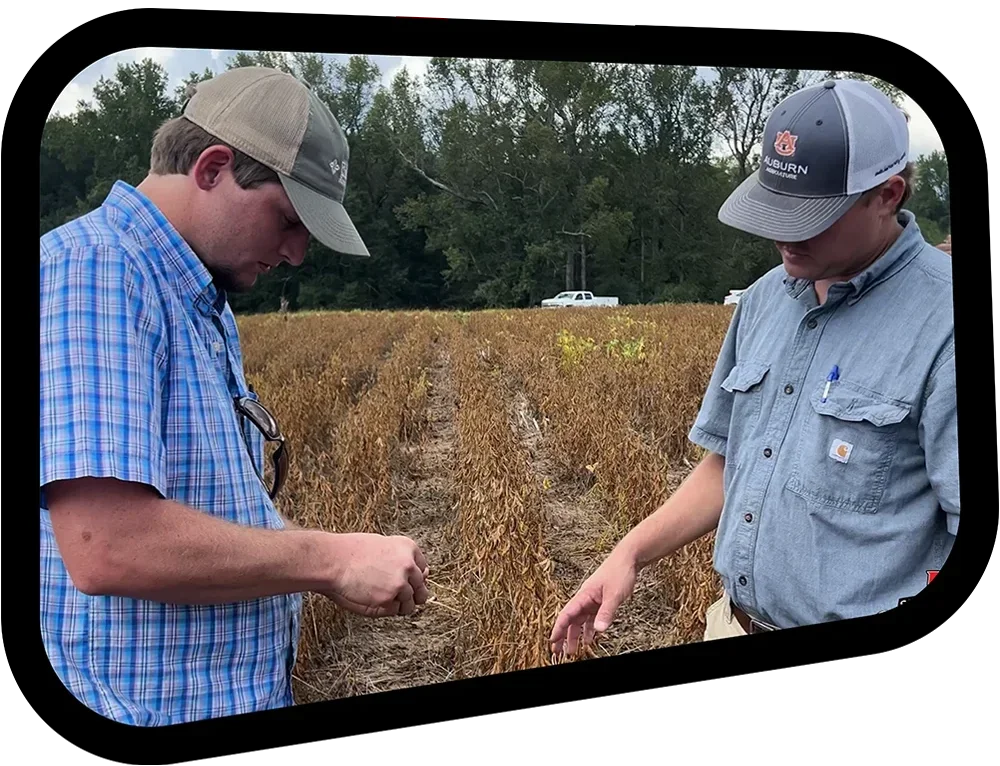

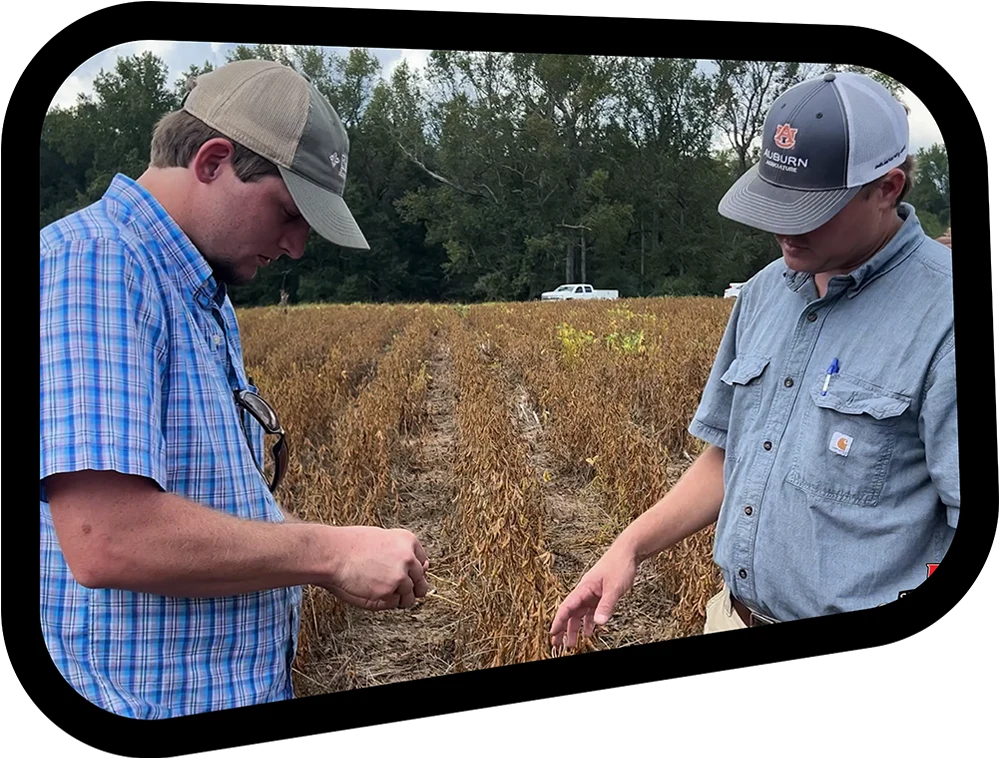
Starting in January 2026, Alabama Extension became the presenting sponsor of Simply Southern TV, which is produced by the Alabama Farmers Federation. Every episode of the 30-minute show now includes a full segment focused on Alabama Extension programs and educational efforts.
Mike Clardy, communications director for Alabama Extension, said this step is helping reach a new audience with timely information.
“Our partnership with the Alabama Farmers Federation reflects a shared commitment to education, service and storytelling,” Clardy said. “Together, we’re highlighting the people, programs and research that strengthen agriculture, families and communities across the state.”

“Back then, we provided content for every other episode, and the focus was really on gardening and home horticulture,” Clardy said. “Eventually, we branched out and provided segments about other program areas. This new agreement allows us to do even more and gives us additional airtime to tell those impactful stories every week.”
Jeff Helms, communications director for the Alabama Farmers Federation, said the increased partnership is a testament to the strong relationship that exists between the two organizations.

Through its history, Simply Southern TV has shared the state’s best stories focused on farming, gardening, forestry, rural living and youth in agriculture. Those stories have been discovered all over Alabama, from its highways and backroads to its barnyards and metros.

During an on-set interview, viewers learned more about new Alabama Extension Director Eve Brantley and her vision for the organization. Among other topics, these features have promoted the importance of soil testing; provided an update on cotton jassid, a new pest for Alabama cotton farmers; covered the Your Money, Your Life financial education program; and introduced the Green Up Alabama initiative.

New episodes for the second half of season 12 begin airing in July.
How to Watch

Simply Southern TV airs on Sunday mornings on five broadcast stations in Alabama. Those stations and airtimes include the following:
- WAKA 8 out of Montgomery at 5:30 a.m.
- EEAR 15 out of Mobile at 6 a.m. (formerly WPMI)
- WBMA 33/40 out of Birmingham at 6:30 a.m.
- WAFF 48 out of Huntsville at 9 a.m.
- WNCF 32 out of Montgomery at 10:30 a.m.
To reach additional viewers, all episodes are available on the YouTube channel and Facebook page for Simply Southern TV.
For more information, visit simplysoutherntv.net.




Agriculture Merch Store




Auburn Extension specialists help cotton farmers identify, respond to new cotton jassid
In this video, Associate Professor Alana Jacobson and Extension Entomologist Scott Graham introduce the two-spot cotton leaf hopper — also known as the cotton jassid — and explain how this Old World pest arrived in the U.S. and why its rapid movement across the region has raised concern.
Watch now to learn how the insect was first detected, how monitoring programs were established, and what early research is revealing about its biology and behavior in Alabama fields.
Peace on the Plains
It’s the cows.
Grazing at Auburn’s Beef Teaching Center, they remind her of the one she raised growing up in Sandersville, Georgia — a life far removed from the bustle of Atlanta where her son Marquez and his wife Kristin were raised.
By the time the Worthams arrived on the Plains, they had been through the wringer. Since, Auburn has offered something like peace to these two resilient master’s degree candidates.
From music education and social work to graduate assistantships in agriculture and forestry, the Worthams have rebuilt their careers from the ground up. Theirs is a story of both personal and professional triumphs amidst adversity.


“I was literally getting about two hours of sleep every day,” he said. “My wife kept saying, ‘You’re going to crash.’”
Marquez attended Bethune–Cookman University in Daytona Beach, Florida, where he was a member of the Marching Wildcats band. A percussionist from the age of 3, he was debating getting additional credentials to teach music at a higher level.
“One night on my mechanical technician job, I was just praying, just asking for different signs,” he said. “And something came into my head: Apply for school.
“And I thought: No.”
A few days later, he spoke with his childhood friend Aaron Golson, who was working on a master’s degree at South Carolina State University. Golson told him about USDA scholarships for minorities studying agriculture.
“He was like, ‘Your people come from agriculture, and you manage an urban farm now. Why don’t you just go back to school for agriculture?’” Marquez recalled. “And I was again like, no, I don’t want to start over.”
The final push came one morning, when Marquez had just returned home from his night shift. He had a little time to run to the store before heading to his teaching job. He was gone maybe 10 minutes.
As he reentered his neighborhood, he sees a helicopter flying low. There was yellow tape blocking his street.
“I live right there,” he told an officer. “And I just left.”
A neighbor pointed to a slope just outside their home.
At the bottom was the body of a man who’d been killed the night before.
“And I just knew, there’s no way in the world I could have a child here, a daughter waking up to a dead body 15 feet from our house,” he said. “That’s no way to live.”
That week he began applying for schools.
“When you have children or you’re considering children, it’ll make you put things into a totally different perspective,” he said. “That was the main thing that prompted me.”

He immediately called Golson, who pointed Marquez to South Carolina State University and to two people that helped shape Marquez’s experience at the university, Dr. William Whitaker and Dr. Christopher Mathis.
“I went to go talk to [Dr. Whitaker], and he registered me for classes that day,” Marquez said.
With Mathis’s help, Marquez secured a USDA Ag Innovation Scholarship, which covered tuition, fees, books — even a meal plan. It was the first of many moments that would feel, in hindsight, providential.
But as doors opened academically and financial burdens began to lift, life at home was unraveling.
Shortly after the move, Kristin’s father passed away. Amid the grief, they discovered she had been pregnant and miscarried.
They hadn’t been trying, but the loss made them realize how much they wanted a child. So, they tried again. And again.
One pregnancy ended with an ectopic loss treated with medication. The next — also ectopic — ended in emergency surgery after one of Kristin’s fallopian tubes ruptured. Both occurred within the span of one year.
After the third loss, the Worthams set the dream of parenthood aside to focus on another: their studies.


“It kind of catapulted me to thinking about continuing with my studies in agriculture, going on to school at the graduate level,” he said.
As he approached the completion of his Bachelor of Science in nutritional sciences at South Carolina State, Marquez started applying for graduate studies at the schools he’d interacted with through MANRRS.
One of those was Auburn.
“By that point I had done an internship with Georgia Extension and another with UGA College of Ag Emerging Scholars research, and I thought for sure I was going to Georgia,” he said. “But I met [Auburn MANRRS Advisor Michelle Cole] at a national conference, so I applied here as well.”
Meanwhile, Kristin was considering a career pivot of her own. With a bachelor’s degree in sociology, she’d worked in veteran’s affairs for more than 12 years, between organizations in Atlanta and South Carolina.
“I loved working directly with veterans, advocating on their behalf to help them obtain housing and other resources,” Kristin said. “But everything that comes with that takes a toll.”
After the death of her father, Kristin began learning about heirs property: what happens when a person dies without a legally binding will to transfer their real estate to their heirs.
“Because my family is one of the thousands affected, I thought that transitioning to forestry would not only be something useful for myself and my family, but something that could bridge social work and natural resource management,” she said.
Marquez suggested Kristin reach out to Cole – an academic administrator in the College of Forestry, Wildlife and Environment at Auburn. She did, applied, and about a month later was accepted.
“Marquez and Kristin represent exactly what MANRRS is all about — leadership, resilience and a commitment to growing both personally and professionally,” Cole said. “I still remember meeting Marquez at a MANRRS conference, where we connected instantly while he was serving as a National Ambassador. From that moment, I saw his potential and knew Auburn could be a place where both he and Kristin could thrive. Today, they are not only strong scholars but individuals who continue to pour back into the MANRRS community while advancing their research.
“Their story is one of perseverance, partnership and purpose,” Cole added, “and I am incredibly proud they chose Auburn for this next chapter of their journey.”
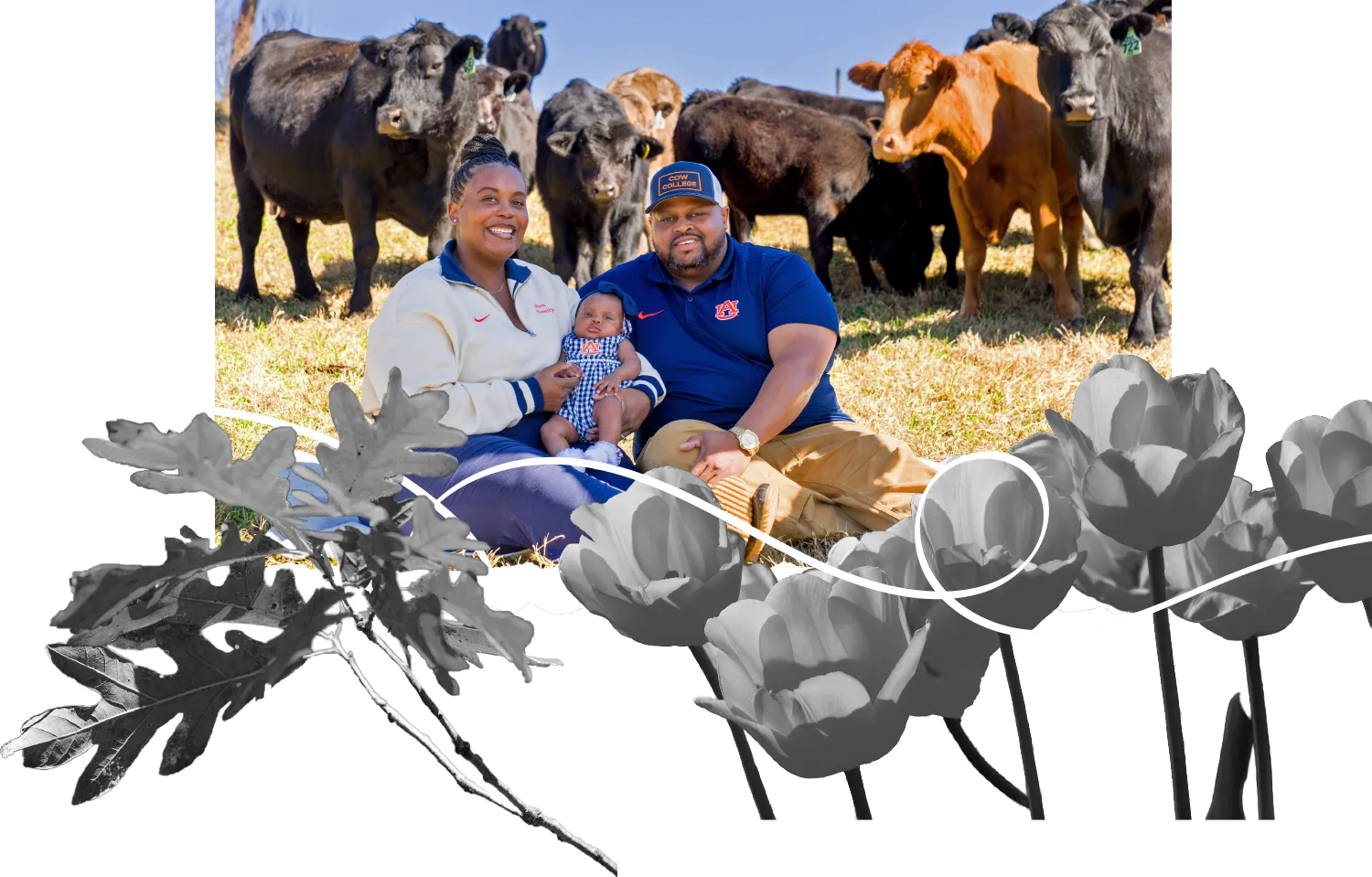

Then, on a visit home to Atlanta, something felt different. She’s been throwing up but didn’t feel sick either. She wanted to have a drink with friends when her mother said, “I don’t think you should do that.”
“I don’t think there is an adjective that I could use to tell you the emotions I felt when I found out I was pregnant,” she said. “I remember screaming with pure joy while still in the restroom. Quez was sitting in the living room and was concerned, naturally. I called his name, and he ran to me immediately. I showed him the test and he grinned so wide. It was the best feeling ever.”
This time, the pregnancy held and was relatively drama-free.
That is, until Kristin broke her tibia at 28 weeks pregnant.
They were in Jackson, Mississippi, at a Tuskegee University game. Kristin was trying to shield her stomach from being bumped in a crowded aisle when she twisted just wrong and fell. The injury required surgery.
“Having surgery while pregnant was not on my bingo card,” she joked.
She had an epidural and was awake for the entire procedure — the option that prioritized her baby girl’s safety.
Then, from September through November, she had to stay off her leg completely. They lived on the second floor of their apartment. Multiple times a week, she had appointments for her leg or for the baby.

For every appointment, firefighters would carry Kristin down the stairs and out of the building so Marquez could drive her to her appointment. They’d help bring her back up to the Worthams apartment after each one.
“We live literally one block from the Fire Department on Ross Street, so they didn’t have to commute far,” she said. “Initially, it was a little embarrassing for me to be carried down two flights of steps on what was essentially a moving tarp, but they were always so kind and helpful.”
Over time, the fire department became part of the Wortham family story. They teased the couple about baby names, arguing over whether the child would be named after them.
On one of their final visits before delivery, one of the regular firefighters who they had known only as “Bass” offered his first name instead.
“He said, ‘Well, my first name is McKinley,’” Marquez remembered.
They liked it.
On December 5, 2025, baby Myah McKinley Wortham was born — healthy, full-term, and long-awaited.
“It’s been a wild ride to say the least,” Marquez said. “But we’re definitely blessed and very, very fortunate and grateful to be here at Auburn.”
For the Worthams, Auburn has been more than a graduate school stop. It has been a place of healing.
“Marquez is a cheerful individual who has absolutely had to make lemonade out of lemons,” said his graduate advisor Jenny Koebernick, associate professor in the Department of Crop, Soil & Environmental Sciences. “He thankfully is on the other side of his challenges, and now it’s full steam ahead to finishing his graduate work.”
His other advisor agreed.
“Marquez is one of the special ones,” said Brandon Smith, assistant professor of ruminant nutrition in forage systems. “His back story and how he came into an interest in agriculture has been truly inspiring, and I feel like I learn a little more about him every time we meet. It’s never easy to go into a program where you are split between advisors or departments, but Marquez has handled that in stride and stands to be an asset to agricultural education in the future.”
Marquez plans to stay in academia, with his sights on a Ph.D. next. His hope is to help students — like the one he used to be — who don’t quite know how an agriculture degree might work for them.
Kristin said the well-deserved peace they’ve long awaited will truly come when they walk across the commencement stage.
“But I can say that Auburn has given me a new perspective on the importance of having a strong community to support you, even if it is just a few solid people in your life,” she said. “That matters.”
Here — after the wringer, after the waiting — there is a baby girl named Myah McKinley Wortham. There are degrees nearly completed. There are cows in the pasture and a quiet place to raise a child.
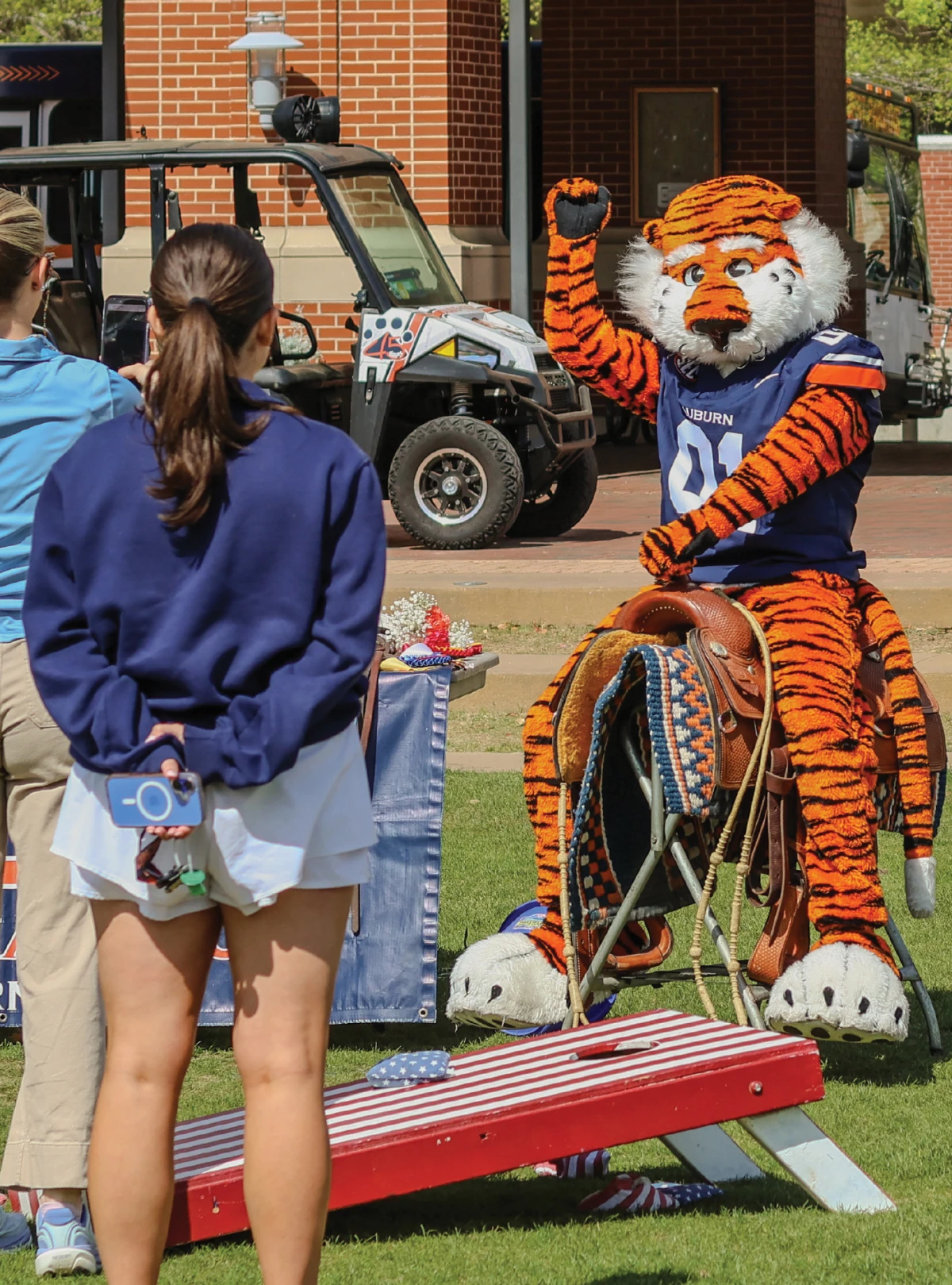

Photo Essay:
Beyond the Farm


“I chose Auburn because of its academic diversity. Here, every major and discipline comes together integrating a true sense of family — the Auburn Family.”



Building the Future Support the new STEM+Ag Complex

This is more than a facility — it’s the future of our industry, and you can be part of it.
Join us in supporting the next generation of ag leaders.
Up Close & Somewhat Personal

An informal Q&A with
Henry Jordan
Henry Jordan
- Research Professional and Agronomist, the University of Georgia Variety Testing
- Environmental Specialist, Georgia DNR Environmental Protection Division

HJ: The variety testing manager is responsible for keeping the program running. I don’t know if anything is off the list. Somewhere in every job description, there is a catch-all clause that says “other duties as assigned” or something similar. Always read the fine print!
Auburn’s Official Variety Testing (OVT) program is somewhat unique. The OVT team includes me, one quarter of a full-time employee, and several undergraduate students. There is no way a handful of people could conduct the number of trials we run each year — approximately 20% of the projects conducted at the Alabama Agricultural Experiment Station. That statistic usually surprises people who haven’t heard it before.


Granny B’s Blueberry Salad
Lauren and her family live on a farm in Springville, Alabama.
“I grew up with animals,” Lauren said, “raising livestock, showing livestock, all of that.”
Agriculture has always been a part of her life, much like Granny B’s Blueberry Salad.
“We make it for just about every holiday,” she said.
Elizabeth Barfield — known as Granny B to her family — is Lauren’s great-grandmother and one of the many hands that has tended to the family farm.
“She was out on the farm and would work her butt off,” Lauren said, “but she was also a girly girl.
“Everyone tells me that I’m just like her,” said Lauren, who was Miss Springville, Alabama, “which is weird because we didn’t really have much time together.”
Granny B passed away when Lauren was 2, but her vivacious spirit is still alive.
“She just loved to dance,” Lauren said. “She could do the Charleston like nobody else.”
Holidays — always accompanied by blueberry salad — give Lauren and her family the perfect opportunity to share sweet memories of their beloved Granny B.
“She was so adored by my family,” she said. “It feels like I know her.”

—Lauren Isley

Elizabeth Barfield’s Blueberry Salad
Ingredients
Salad
- 1 (16 oz) can blueberries with juice
- 1 (8 oz) can crushed pineapple with juice
- 1 (3 oz) package black cherry gelatin
- 1 (3 oz) package raspberry gelatin
- 2 cups boiling water
Topping
- 1 (8 oz) package cream cheese
- 1/2 cup sugar
- 1 (8 oz) container sour cream
- 1/2 tsp vanilla
- 1/2 cup chopped pecans
Instructions
- Drain blueberries and pineapples, reserve juice
- Dissolve gelatin in boiling water
- Add 1 cup pineapple and blueberry juice, combined
- Stir in drained fruit and pour into a 13x9x2 dish
- Refrigerate to congeal
- Soften cream cheese and fold in sugar, sour cream, vanilla and pecans
- Spread over the congealed salad
Elizabeth Barfield’s Blueberry Salad
Ingredients
Salad
- 1 (16 oz) can blueberries with juice
- 1 (8 oz) can crushed pineapple with juice
- 1 (3 oz) package black cherry gelatin
- 1 (3 oz) package raspberry gelatin
- 2 cups boiling water
Topping
- 1 (8 oz) package cream cheese
- 1/2 cup sugar
- 1 (8 oz) container sour cream
- 1/2 tsp vanilla
- 1/2 cup chopped pecans
Instruction
- Drain blueberries and pineapples, reserve juice
- Dissolve gelatin in boiling water
- Add 1 cup pineapple and blueberry juice, combined
- Stir in drained fruit and pour into a 13x9x2 dish
- Refrigerate to congeal
- Soften cream cheese and fold in sugar, sour cream, vanilla and pecans
- Spread over the congealed salad

Cooking Tools
- Spatula
- 9x13x2 dish
-
Executive Editor
Josh Woods
-
Managing Editor
Kristen Bowman
-
Digital Editor
Cheri Cannon
-
CONTRIBUTING Writers
Claire Hamilton
Mike Jernigan
Kacey Watson
Mary Wilson -
Layout & Design
Jess Ramspeck Douglas
-
Photographers
Alabama Cooperative Extension System
Nick Allen
Jonah Enfinger
Keema Miller
Katie Nichols -
CONTRIBUTING Videographer
Bridget Brown
-
Interim Dean
Arthur Appel
-
Auburn University College of Agriculture
Office of Agricultural Communications and Marketing
5010 Haley Center
Auburn, AL 36849-5401
334-844-5887
theseason@auburn.edu
agriculture.auburn.edu
Auburn University is an equal opportunity educational institution/employer. -
© 2026 Auburn University College of Agriculture