

Peace on the Plains
It’s the cows.
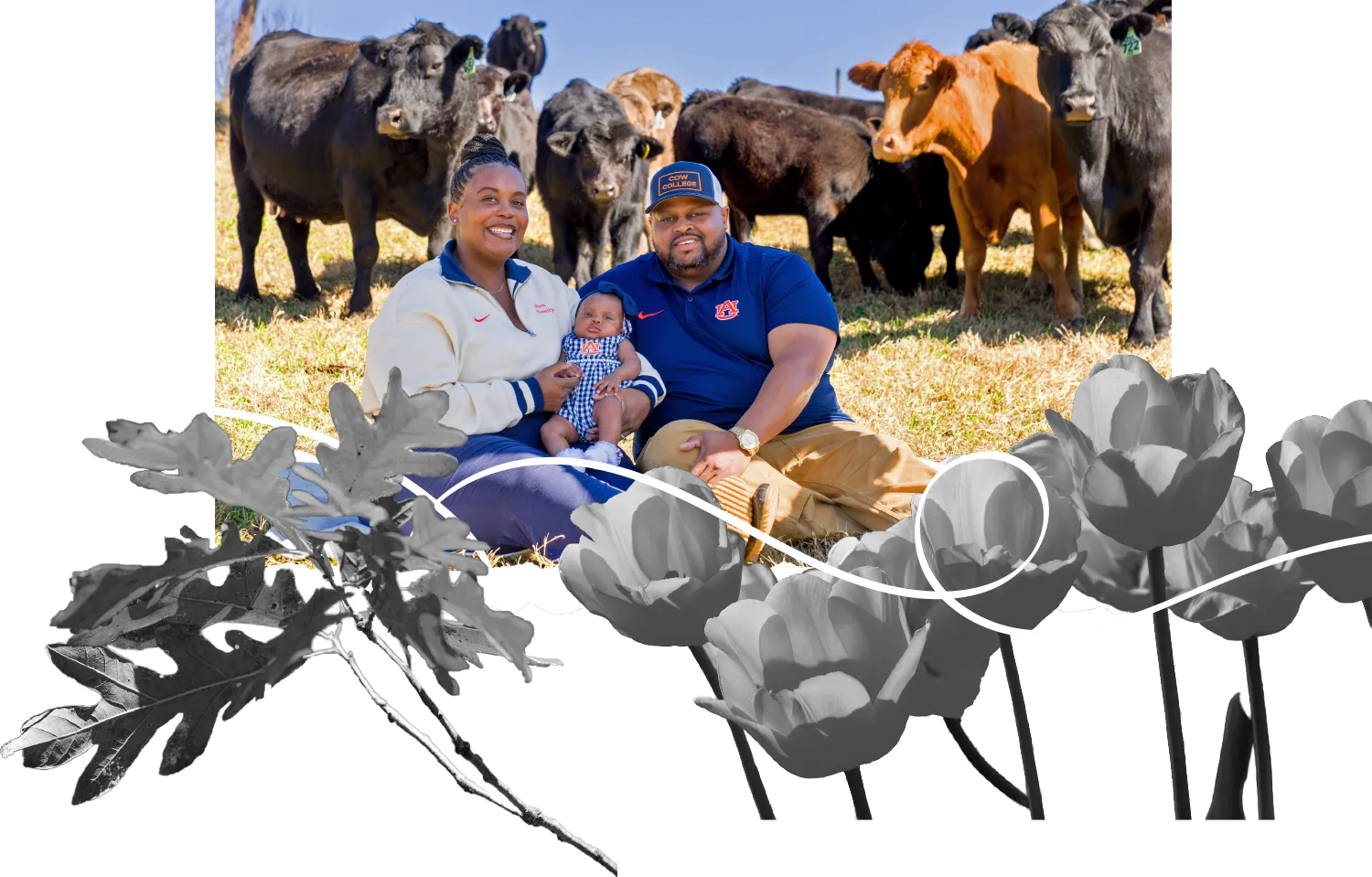
Grazing at Auburn’s Beef Teaching Center, they remind her of the one she raised growing up in Sandersville, Georgia — a life far removed from the bustle of Atlanta where her son Marquez and his wife Kristin were raised.
By the time the Worthams arrived on the Plains, they had been through the wringer. Since, Auburn has offered something like peace to these two resilient master’s degree candidates.
From music education and social work to graduate assistantships in agriculture and forestry, the Worthams have rebuilt their careers from the ground up. Theirs is a story of both personal and professional triumphs amidst adversity.


“I was literally getting about two hours of sleep every day,” he said. “My wife kept saying, ‘You’re going to crash.’”
Marquez attended Bethune–Cookman University in Daytona Beach, Florida, where he was a member of the Marching Wildcats band. A percussionist from the age of 3, he was debating getting additional credentials to teach music at a higher level.
“One night on my mechanical technician job, I was just praying, just asking for different signs,” he said. “And something came into my head: Apply for school.
“And I thought: No.”
A few days later, he spoke with his childhood friend Aaron Golson, who was working on a master’s degree at South Carolina State University. Golson told him about USDA scholarships for minorities studying agriculture.
“He was like, ‘Your people come from agriculture, and you manage an urban farm now. Why don’t you just go back to school for agriculture?’” Marquez recalled. “And I was again like, no, I don’t want to start over.”
The final push came one morning, when Marquez had just returned home from his night shift. He had a little time to run to the store before heading to his teaching job. He was gone maybe 10 minutes.
As he reentered his neighborhood, he sees a helicopter flying low. There was yellow tape blocking his street.
“I live right there,” he told an officer. “And I just left.”
A neighbor pointed to a slope just outside their home.
At the bottom was the body of a man who’d been killed the night before.
“And I just knew, there’s no way in the world I could have a child here, a daughter waking up to a dead body 15 feet from our house,” he said. “That’s no way to live.”
That week he began applying for schools.
“When you have children or you’re considering children, it’ll make you put things into a totally different perspective,” he said. “That was the main thing that prompted me.”

He immediately called Golson, who pointed Marquez to South Carolina State University and to two people that helped shape Marquez’s experience at the university, Dr. William Whitaker and Dr. Christopher Mathis.
“I went to go talk to [Dr. Whitaker], and he registered me for classes that day,” Marquez said.
With Mathis’s help, Marquez secured a USDA Ag Innovation Scholarship, which covered tuition, fees, books — even a meal plan. It was the first of many moments that would feel, in hindsight, providential.
But as doors opened academically and financial burdens began to lift, life at home was unraveling.
Shortly after the move, Kristin’s father passed away. Amid the grief, they discovered she had been pregnant and miscarried.
They hadn’t been trying, but the loss made them realize how much they wanted a child. So, they tried again. And again.
One pregnancy ended with an ectopic loss treated with medication. The next — also ectopic — ended in emergency surgery after one of Kristin’s fallopian tubes ruptured. Both occurred within the span of one year.
After the third loss, the Worthams set the dream of parenthood aside to focus on another: their studies.


“It kind of catapulted me to thinking about continuing with my studies in agriculture, going on to school at the graduate level,” he said.
As he approached the completion of his Bachelor of Science in nutritional sciences at South Carolina State, Marquez started applying for graduate studies at the schools he’d interacted with through MANRRS.
One of those was Auburn.
“By that point I had done an internship with Georgia Extension and another with UGA College of Ag Emerging Scholars research, and I thought for sure I was going to Georgia,” he said. “But I met [Auburn MANRRS Advisor Michelle Cole] at a national conference, so I applied here as well.”
Meanwhile, Kristin was considering a career pivot of her own. With a bachelor’s degree in sociology, she’d worked in veteran’s affairs for more than 12 years, between organizations in Atlanta and South Carolina.
“I loved working directly with veterans, advocating on their behalf to help them obtain housing and other resources,” Kristin said. “But everything that comes with that takes a toll.”
After the death of her father, Kristin began learning about heirs property: what happens when a person dies without a legally binding will to transfer their real estate to their heirs.
“Because my family is one of the thousands affected, I thought that transitioning to forestry would not only be something useful for myself and my family, but something that could bridge social work and natural resource management,” she said.
Marquez suggested Kristin reach out to Cole – an academic administrator in the College of Forestry, Wildlife and Environment at Auburn. She did, applied, and about a month later was accepted.
“Marquez and Kristin represent exactly what MANRRS is all about — leadership, resilience and a commitment to growing both personally and professionally,” Cole said. “I still remember meeting Marquez at a MANRRS conference, where we connected instantly while he was serving as a National Ambassador. From that moment, I saw his potential and knew Auburn could be a place where both he and Kristin could thrive. Today, they are not only strong scholars but individuals who continue to pour back into the MANRRS community while advancing their research.
“Their story is one of perseverance, partnership and purpose,” Cole added, “and I am incredibly proud they chose Auburn for this next chapter of their journey.”

Then, on a visit home to Atlanta, something felt different. She’s been throwing up but didn’t feel sick either. She wanted to have a drink with friends when her mother said, “I don’t think you should do that.”
“I don’t think there is an adjective that I could use to tell you the emotions I felt when I found out I was pregnant,” she said. “I remember screaming with pure joy while still in the restroom. Quez was sitting in the living room and was concerned, naturally. I called his name, and he ran to me immediately. I showed him the test and he grinned so wide. It was the best feeling ever.”
This time, the pregnancy held and was relatively drama-free.
That is, until Kristin broke her tibia at 28 weeks pregnant.
They were in Jackson, Mississippi, at a Tuskegee University game. Kristin was trying to shield her stomach from being bumped in a crowded aisle when she twisted just wrong and fell. The injury required surgery.
“Having surgery while pregnant was not on my bingo card,” she joked.
She had an epidural and was awake for the entire procedure — the option that prioritized her baby girl’s safety.
Then, from September through November, she had to stay off her leg completely. They lived on the second floor of their apartment. Multiple times a week, she had appointments for her leg or for the baby.

For every appointment, firefighters would carry Kristin down the stairs and out of the building so Marquez could drive her to her appointment. They’d help bring her back up to the Worthams apartment after each one.
“We live literally one block from the Fire Department on Ross Street, so they didn’t have to commute far,” she said. “Initially, it was a little embarrassing for me to be carried down two flights of steps on what was essentially a moving tarp, but they were always so kind and helpful.”
Over time, the fire department became part of the Wortham family story. They teased the couple about baby names, arguing over whether the child would be named after them.
On one of their final visits before delivery, one of the regular firefighters who they had known only as “Bass” offered his first name instead.
“He said, ‘Well, my first name is McKinley,’” Marquez remembered.
They liked it.
On December 5, 2025, baby Myah McKinley Wortham was born — healthy, full-term, and long-awaited.
“It’s been a wild ride to say the least,” Marquez said. “But we’re definitely blessed and very, very fortunate and grateful to be here at Auburn.”
For the Worthams, Auburn has been more than a graduate school stop. It has been a place of healing.
“Marquez is a cheerful individual who has absolutely had to make lemonade out of lemons,” said his graduate advisor Jenny Koebernick, associate professor in the Department of Crop, Soil & Environmental Sciences. “He thankfully is on the other side of his challenges, and now it’s full steam ahead to finishing his graduate work.”
His other advisor agreed.
“Marquez is one of the special ones,” said Brandon Smith, assistant professor of ruminant nutrition in forage systems. “His back story and how he came into an interest in agriculture has been truly inspiring, and I feel like I learn a little more about him every time we meet. It’s never easy to go into a program where you are split between advisors or departments, but Marquez has handled that in stride and stands to be an asset to agricultural education in the future.”
Marquez plans to stay in academia, with his sights on a Ph.D. next. His hope is to help students — like the one he used to be — who don’t quite know how an agriculture degree might work for them.
Kristin said the well-deserved peace they’ve long awaited will truly come when they walk across the commencement stage.
“But I can say that Auburn has given me a new perspective on the importance of having a strong community to support you, even if it is just a few solid people in your life,” she said. “That matters.”
Here — after the wringer, after the waiting — there is a baby girl named Myah McKinley Wortham. There are degrees nearly completed. There are cows in the pasture and a quiet place to raise a child.