

The Sky’s the Limit
In war, drones have become ubiquitous with death and destruction, as opposing sides have pushed the technology further than ever before in search of a battlefield advantage. On another level, privately operated drones have become a frequent nuisance, sometimes closing airports, disrupting mass events or invading people’s privacy.
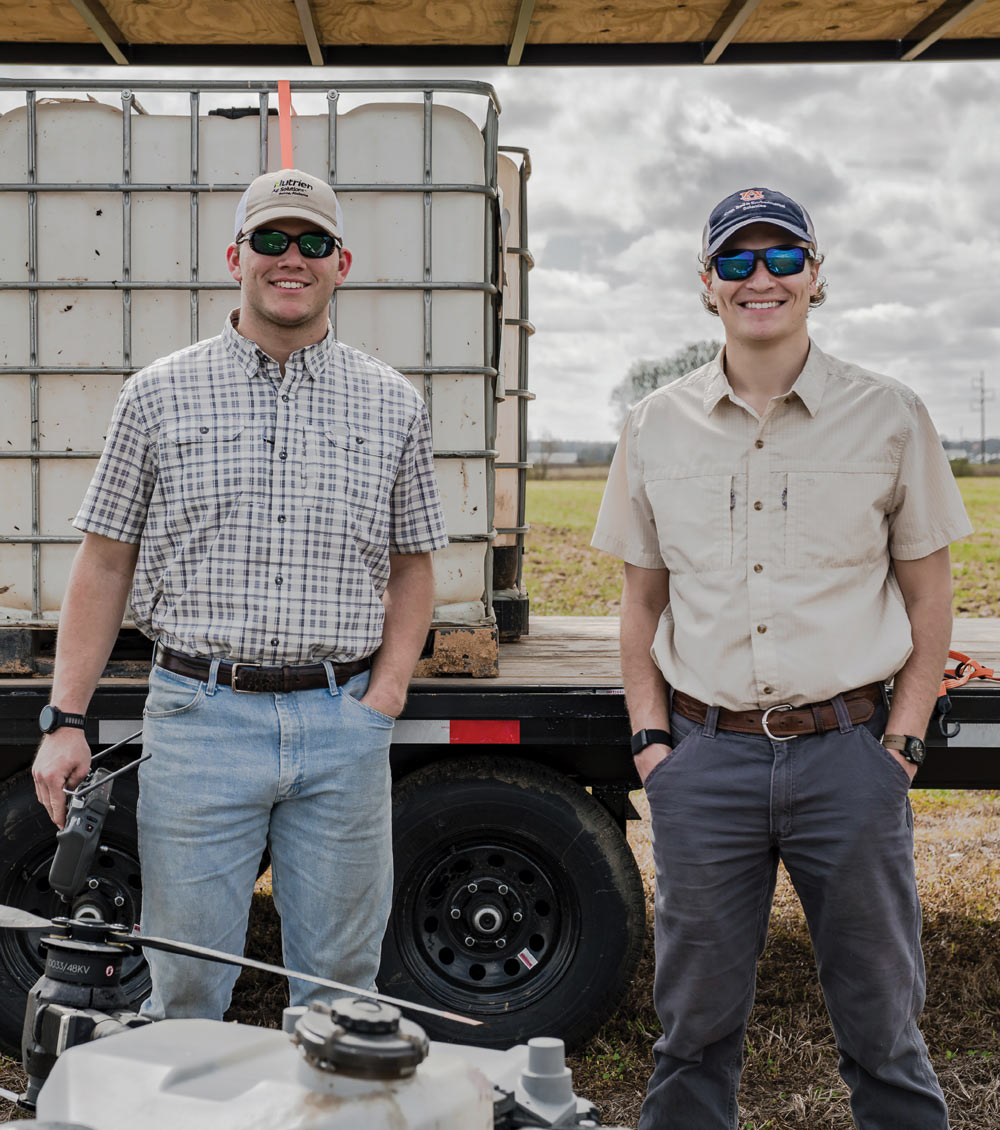
But two recent graduates from the Auburn University College of Agriculture, John Hixon and Carter Engle, are hoping to convince more people — especially Alabama farmers — to see drones in an entirely different light.
While finishing school, they launched Elevated Ag Drone Services (EADS), which provides agricultural drone services for the application of pesticides on crops, spraying herbicides on weeds and numerous other applications where drones can save time and money over more traditional technologies.
Ironically, neither Hixon nor Engle came from agricultural backgrounds prior to coming to Auburn and the College of Agriculture. “I just knew I loved being outside and wanted a career that allowed me to work outdoors,” Hixon said. “That led me to choose an agricultural major, and I haven’t looked back since.”
For his part, Engle first declared a major in pre-med when he arrived on the Plains. He soon decided he wanted something different, and his friend Hixon thought he knew just the thing. He encouraged Engle to make the switch to agriculture, and it didn’t take long for the switch to become permanent.



“During spring of my freshman year at Auburn I was looking for a summer job and a pledge brother told me about a position he had held before with the college,” Hixon recalled. “I met with Dr. Steve Li, and he explained his projects with agricultural drones. I had never even heard of agricultural drones before that, but it sounded fascinating, and I really fell in love with it. I ended up spending two summers working with him, and that’s where my interest really began.”
Li, an Associate Professor and Extension Specialist in the Department of Crop, Soil & Environmental Sciences, is one of the nation’s foremost experts on the use of drones in agriculture. He has worked closely with the Alabama Farmers Federation to demonstrate drone technology across the state and reaches subscribers in 25 countries with his online educational content.
Engle once again followed Hixon’s lead and also ended up working with Li. “After John’s first summer working with Dr. Li, he encouraged me to come join the team and check out the drones,” Engle said. “It sounded like a great opportunity to stay in Auburn for the summer and work with some good guys. Little did I know how interesting the drone technology would be.
“Dr. Li played a huge role in the start of my interest in drones,” he continued. “Without him I probably never would have discovered this path. Even now he continues to pour into us and is always willing to answer questions or help however he can.”
According to Li, Hixon and Engle not only had a burning desire to learn as much as possible, but they also possessed another very important characteristic necessary to success in agricultural drone work.
“They had an exceptional work ethic and were never afraid of hot and dirty work outside in the middle of the summer,” Li said. “They took on the toughest jobs with a great attitude and were always eager to learn new things.”
The two were so eager, in fact, that with Li’s help they soon started looking for opportunities to work with established companies so they could expand their knowledge even more.
“We were running research trials and wanted to get more hands-on experience flying spray drones,” Engle explained. “Dr. Li posted our contact information in a Facebook group for spray drone operators and from there, we started calling the numbers in the comments. After many phone calls we found a company in Tuttle, Oklahoma, willing to let us come work for the summer.”
Hixon and Engle spent that summer living in a tiny fifth-wheel camper and working at Sky Tech, LLC, a small father-son drone operation serving Oklahoma farmers.
“We only had about 15 minutes of combined phone conversation with our boss, Michael Bradford, before heading out there,” Engle remembered. “But the family was amazing and welcomed us like their own.”
It was in Oklahoma, gaining hands-on experience every day in maintaining and operating working agricultural drones, that the pair first had the idea of bringing that experience back home to Alabama and starting their own drone operation.
“Once we started operating the drones and seeing how much acreage they could cover, we realized there was real potential there,” Hixon said. “There was a real demand for that kind of service. That’s when we started thinking about building something of our own.”
“Pretty quickly during our time in Oklahoma we realized this could turn into something long term,” agreed Engle. “We learned the software side of the operation, how to troubleshoot problems in the field and even how to disassemble and repair the drones when needed.


The two also learned more about the regulatory side of the business. Due to drones competing with other aerial vehicles for airspace and their potential for possible misuse, drone operation is highly regulated by federal authorities.
“To open our own business, one of the first steps was obtaining our Federal Aviation Administration (FAA) Part 107 Remote Pilot Certificate, which required passing an in-person exam,” Engle said. “After that, we had to obtain our FAA Part 137 certification, which allows us to operate agricultural aircraft over 55 pounds.
“That process involved months of paperwork and close coordination with the FAA. But there are several certifications and requirements that must be completed before being fully legal to operate.”
But the result of the experience gained with Li in the college and at Sky Tech in Oklahoma is their new company EADS, which for now offers drone applications across several counties surrounding the Auburn area. Hixon and Engle have found the technology to be highly suitable to Alabama agriculture, built as it is mostly around small, family-operated farms.
“Drones are a great fit for smaller properties where aircraft may not be able to operate,” Hixon noted. “They’re also useful when fields are too wet for ground rigs. On top of that, drones can be more affordable compared to other application methods.
“Drones can also save a significant amount of time. In many cases, they can treat fields several times faster than traditional methods, especially in situations where ground equipment can’t access a field due to soil conditions. They allow farmers to respond quickly to problems in their crops, which can make a big difference during critical growing periods.”
“Drones aren’t here to replace crop dusters, helicopters or ground rigs,” added Engle. “They’re here to complement them. They create new opportunities for efficiency, allowing access to areas that were previously difficult to reach and giving farmers another tool that can help improve yields over time.”
The relatively small drones EADS uses have impressive capacity and the ability to get a job done quickly.
“Capabilities vary depending on the job, but the drones we primarily use are around 10 by 10 feet in size and can fly at roughly 32 feet per second,” Hixon said. “They are capable of applying up to 10 gallons of pesticide, herbicide or fertilizer per acre, which allows them to very efficiently treat fields or problem areas while maintaining precise application amounts.”
Hixon and Engle graduated in May with hopes to expand their business to other areas of Alabama and beyond. As far as they can tell, the sky is the limit for the use of agricultural drones in the years ahead.
“Drones aren’t here to take over agriculture, but they are here to help,” predicts Hixon. “I think we’ll see a lot of continuing innovation in the use of them in other areas such as forestry and land management. There’s still so much to discover with this technology.”
“And drones will only continue to improve,” adds Engle. “Looking at a drone from five years ago feels like looking at an iPhone 6 today. The technology is advancing so rapidly that it is very exciting to think about what the next few years will bring.”
