

Beautiful, Beautiful Bees
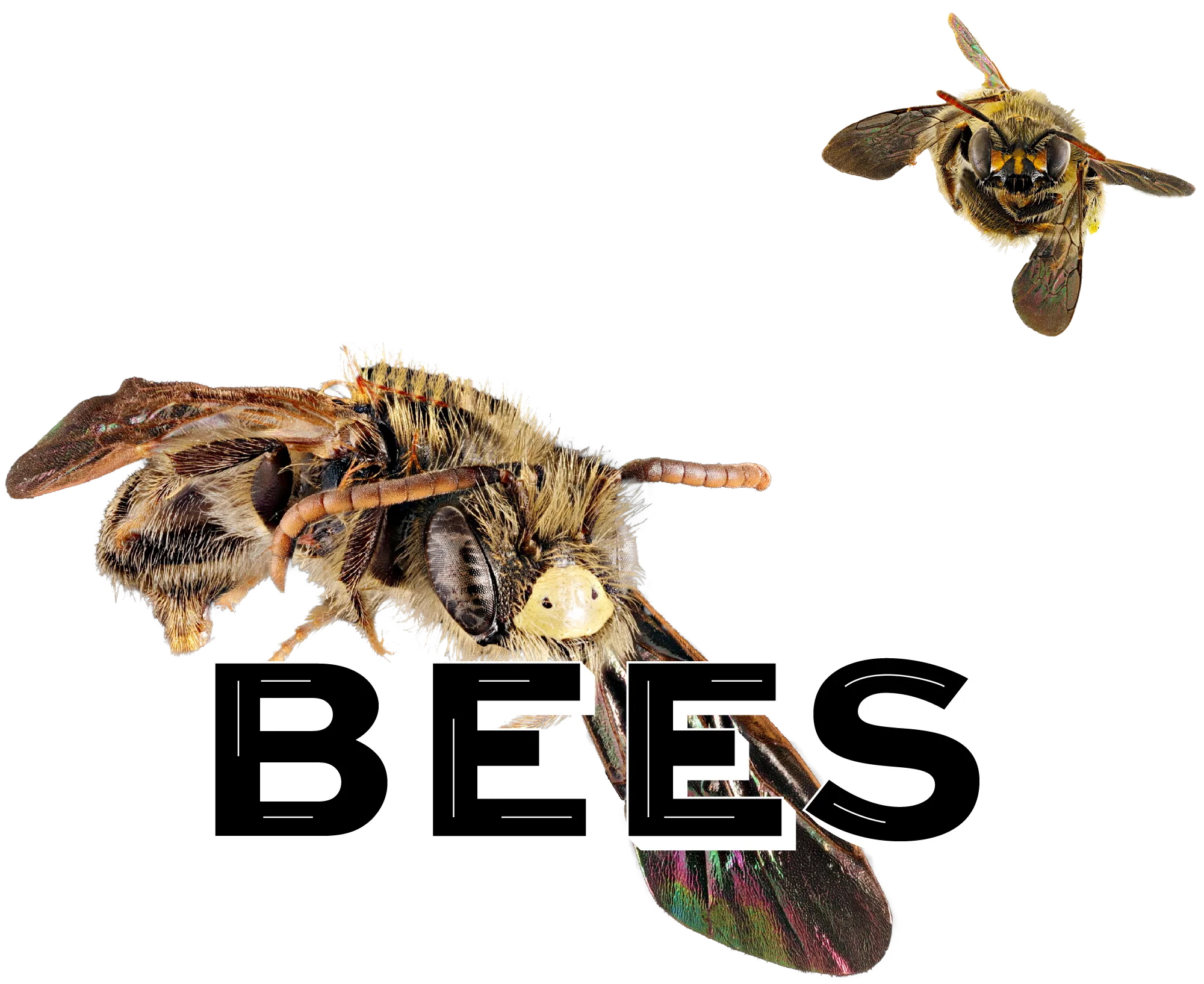

No, this isn’t a creature from the dark corners of Stephen King’s mind. It’s a bee.
Despite their dramatic name, these Smooth-faced Miner bees are timid and likely to zoom quickly away from humans. You’ve probably never seen them in detail, but Assistant Research Professor Anthony Abbate wants to change that.
Abbate and the team in his Native Bee Lab are developing a calendar with high-resolution photos of native bees to raise awareness and identification of native pollinators in Alabama.
“Native bees are extremely diverse,” Abbate said. “There are hundreds of species in Alabama, and a lot of people are unfamiliar with them. This is a way to educate about them and bring these really fascinating animals into the spotlight.”
Abbate uses a macrophotography set up, which comprises a DSLR camera mounted on a stack shot rail system. Put simply, it can take very good pictures of very small things.
“It has many uses,” Abbate explained. “The more obvious ones are creating pictures for, say, publications or for presentations that my lab gives at stakeholder meetings or even scientific meetings like the Entomological Society of America, things like that. But we also use it for outreach. We put out the ACES Monthly Beekeeping Newsletter for beekeepers with a bee of the month and a wildflower of the month.”
– Anthony Abbate

“When you get a bee that’s really hard to identify, like a native bee can be, it takes a long time if you want to take that bee and ship it to an expert,” he said. “So, this has kind of opened up the door for us to take these very detailed pictures, from all sorts of angles, and send an email to an expert who can give us an answer as fast as it takes for him to click open document. That’s been extremely helpful.”
Abbate trains grad students, technicians and visiting scientists on how to use the equipment. It is more involved, he said, than shooting with a typical DSLR.
“If you think about taking a picture of any object, you just get it in focus, you snap a picture, but parts of that object may be out of focus because only one part was the primary focus. What this equipment does is it allows us to take pictures that are basically slices through that object, similar to an MRI. You’re taking multiple pictures through the object, and each of those pictures has a certain part of that object that’s in focus.

The primary purpose of the calendar is to help close the gap when it comes to the identification of native bees in Alabama. According to Abbate, there are more than 20,000 species of bees in the world. Of that, 4,000 are in the United States, and an estimated 500 are in Alabama.
“But we don’t have a great handle on that number, because extensive surveys haven’t been done,” he said.
The 2025 calendar will be interactive with an iNaturalist project hosted on it. Users can take pictures of bees and use the iNaturalist code on the calendar to have Abbate and his team identify the bees. Those interested in purchasing a calendar should follow the College of Agriculture and the AU-Bees lab on social media for details of its release.
While a large goal of the calendar is to increase scientific identification of native bees, Abbate said it is not the only goal. It is also about educating the public.
“Native bees are extremely diverse,” he said. “This calendar will have many bees that are morphologically different from one another. Truthfully, 99% of the population doesn’t even know what these things are. And they don’t know that they’re really, really beautiful.
“You can’t appreciate them as they’re zooming past you.”