

Many Missions

Agriculture
Program Brings
Temple Grandin

Autistic herself, she is widely seen as the rock star of the autism awareness movement, having opened eyes about what it is like to live with the condition and inspired countless numbers of those who, like her, are dealing with it. The challenges she has overcome in her lifetime, from dealing with autism at a time when it was widely misunderstood to being a rare woman in the then-man’s world of the livestock and beef production industry, have made her something of a reluctant superstar and even the subject of a 2010 HBO movie.
But to limit Grandin to only one mission doesn’t do her or her unique mind justice. She is a woman on multiple missions. And on her recent visit to Auburn as a guest of the AU College of Agriculture’s Women in Agriculture program, she was a passionate advocate for all of them.
“I always want to know what I can learn,” she told audiences in several Auburn classes and at a luncheon in her honor during a February 26 visit to campus. “If you think you’ve learned it all then you stagnate. As I’ve gotten older, I want the things I do to impact something real — to make something better. I want to open doors for other people now. I figure that is what I should be doing.”
Now 76, what she is currently doing and what brought her to Auburn is seeking to inspire the students she travels the country to speak to with the same missionary zeal she feels to solve the problems occupying her thoughts every day. Food insecurity. Agricultural sustainability. Education reform. Biofuel production. Her mind is a kaleidoscope of challenges needing solutions, so many that even she can’t get to them all. So she seeks to inspire others to take up the challenge.
Solving problems and opening doors for others has been a thread throughout Grandin’s long career whether for animals, for whom she has designed more humane facilities; other people with autism, who she has urged to never limit their ambitions despite their challenges; or students, many of whom she has helped to follow in her notably large academic footsteps. In fact, “Open Doors” is the title of a new documentary about her life, which was previewed during her visit to campus.
To watch Grandin interact with audiences is to get a glimpse of a mind that takes the old Apple Computer advertising slogan “Think Different” to a whole new level. It’s quickly obvious she is a multitasking machine — wondering simultaneously about things as varied as how the locking mechanism on the door of the airplane she flew to Atlanta that morning works to how grazing animals can actually improve their environment.
She would likely shrug at the thought, but to watch her process so many thoughts at the same time is to get a tiny glimpse of genius, albeit a genius unlike those that most readily come to mind. “I was in my thirties before I realized most other people don’t think in pictures like I do,” she related, with still a hint of that initial surprise in her voice. “I am a visual thinker. When I think of an idea, it is in pictures from my past experience that relate to that concept.”
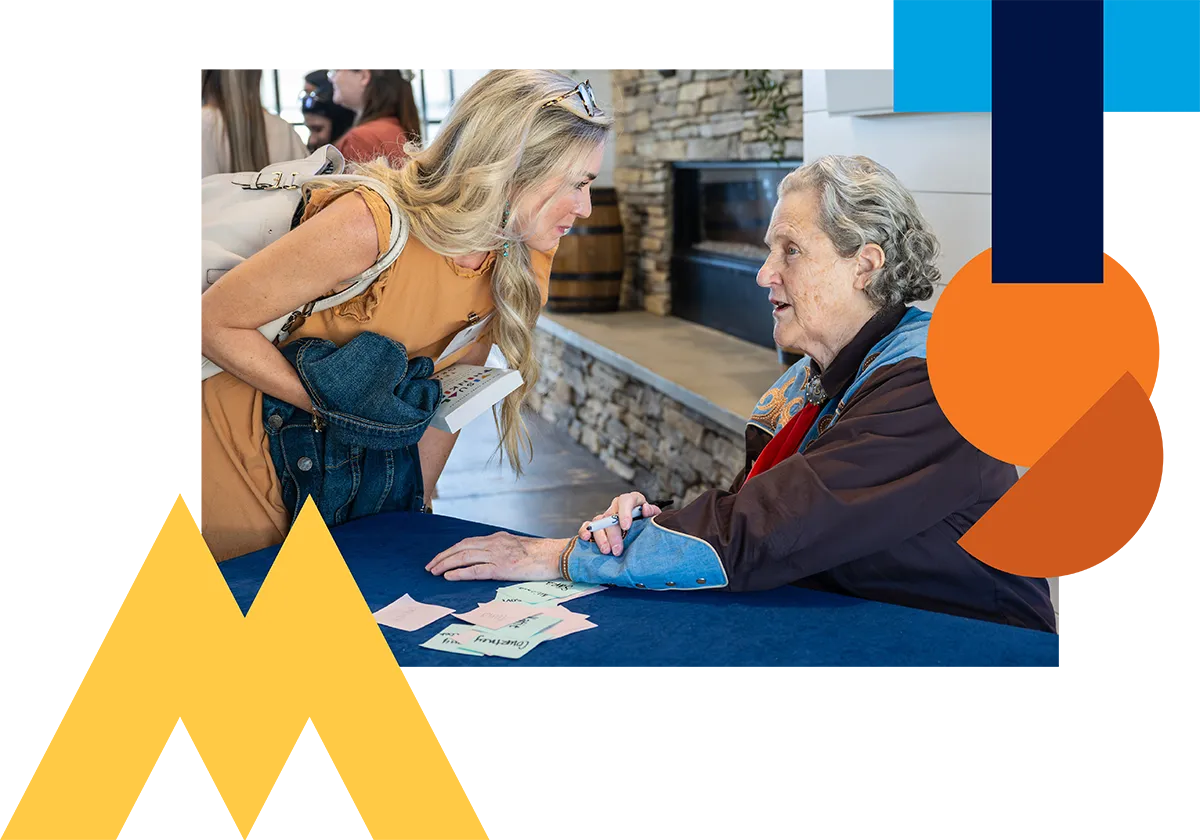
“These young students are tomorrow’s leaders and problem solvers,” she said. “I want to inspire them. I tell them they can’t solve every problem. They need to pick one area they feel a particular passion for and are good at and concentrate on it.”
To the secondary educators in the luncheon audience, she had another message on a similar theme. As a visual thinker, she is fascinated with the “how” of “how things work” and a passionate advocate of bringing skills training back to schools so more students — especially visual thinkers like herself — can discover talents that may lie in the practical realm rather than the academic. In fact, it is the major theme of her latest book, “Visual Thinking: The Hidden Gifts of People Who Think in Pictures, Patterns and Abstractions.”
“What inspired me to write “Visual Thinking” was when I realized the skills we as a nation are losing,” she said, urging educators to rethink their curriculums. “We are paying a gigantic price for taking out all the technical, or hands-on classes from our schools. I get that parents of most kids don’t want their children taking the hands-on classes. They want them to be doctors and lawyers and stuff like that.
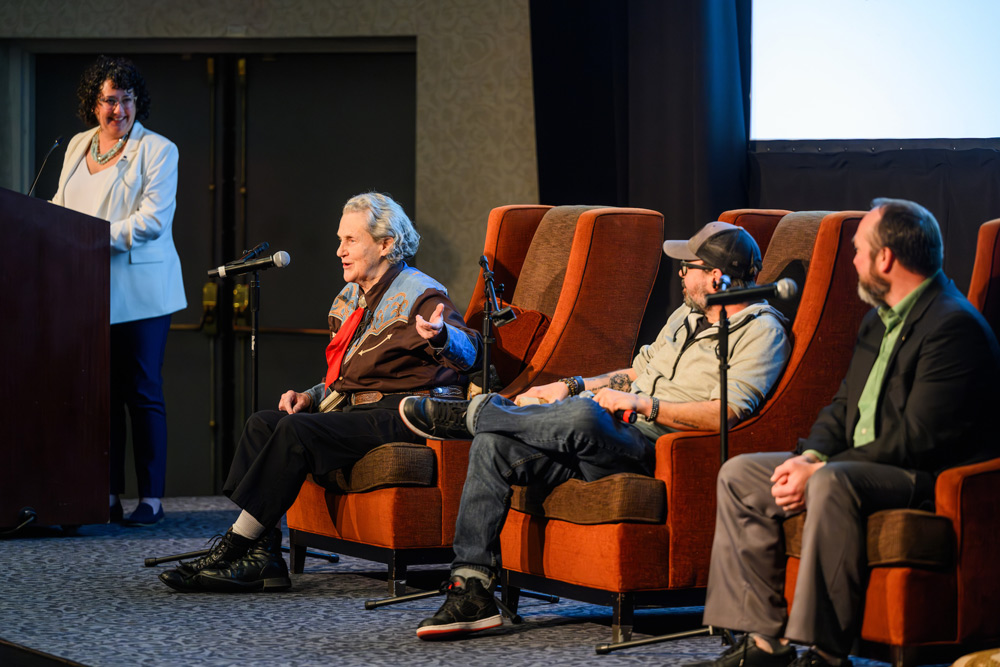
“Time after time,” she concluded, “I have seen similar examples. And it goes back to the educational system. In Europe, students can choose to go to university or go into tech, and they don’t stick their nose up at tech and think of it as some lesser form of thinking. I can tell you it’s not. It is a different kind of thinking. It’s the kind of thinking you need to keep the water systems running.”
And very few people have more understanding of thinking differently than Temple Grandin, whose latest and greatest mission is to inspire the next generation of students and educators — as well as children and adults dealing with autism — to take up the work of solving problems, both their own as well as those of the nation and world. It is a task she herself has spent a more than 50-year career pursuing.
“I’m in my 70s now, and there’s still so much to do,” she noted, ticking off one problem after another that she regularly pictures in her thoughts. “I’m getting older, but I want to continue to travel and encourage students like these here at Auburn to take up those challenges in the years ahead as long as I can. They are the ones that will solve them one day.”